Kakadu: Six Quiet Days in Australia’s Top End
Wetlands, escarpment, ancient rock art and the slow-cooked beauty of the Northern Territory.
📍 Kakadu National Park, Northern Territory, Australia
Kakadu National Park is the biggest national park in Australia, the second biggest in the world, and the kind of place where a two-hour drive can pass maybe three other vehicles, all of them utes, all of them waving. It is UNESCO-listed twice — once for its natural values, once for its cultural — which nearly nowhere on Earth manages. It is the joint-managed traditional country of the Bininj and Mungguy people, who have lived here for about sixty-five thousand years, making it arguably the oldest continuously-inhabited landscape on the planet. And it is, for reasons I cannot fully explain, almost completely empty of tourists.
I went in the dry season, stayed six nights, drove 1,400 kilometres inside the park alone, hiked into gorges, swam under waterfalls, watched ancient rock art from the base of the escarpment it was painted on, and came out of it with the kind of quiet in my head that lasts.
Getting there
Darwin is the gateway. You rent a 4WD at the airport — this is one of the few parts of Australia where the 4WD actually earns its price tag; several Kakadu roads are gravel, some are river-crossings, one is a genuine technical descent — and drive south-east on the Arnhem Highway for about three hours to the Bowali Visitor Centre at Jabiru. Buy your park pass here (about $40, valid seven days), pick up the ranger programme schedule, fill your water bottles, and off you go.
I stayed in three different places over the six days — Jabiru for the rock art, Cooinda for the wetlands, and Mary River for the southern waterfalls. This is the right shape for a big week.
Days one and two: the rock art at Ubirr and Nourlangie
Kakadu’s rock art is the single most extraordinary cultural experience I have had in Australia, and possibly anywhere. Ubirr is a small rock outcrop on the eastern side of the park — a ten-minute walk in from the car park — and the rock walls are covered in layers of paintings that range from two hundred years old (the most recent, including a painting of an early European’s pipe) to over twenty thousand years old (the oldest verified layers). Ochres, charcoal, white clay. Fish, crocodiles, hunters, hand stencils made by pressing a hand to the rock and spraying chewed ochre around it.
A park ranger meets visitors at Ubirr every afternoon in the dry season and explains what you’re looking at. Our ranger was a senior Aboriginal woman named Aunty Maggie, who had been doing this for two decades. She walked us from painting to painting at a slow pace and told us which ones were hers — meaning the ones she had permission to discuss — and pointed to others she couldn’t.
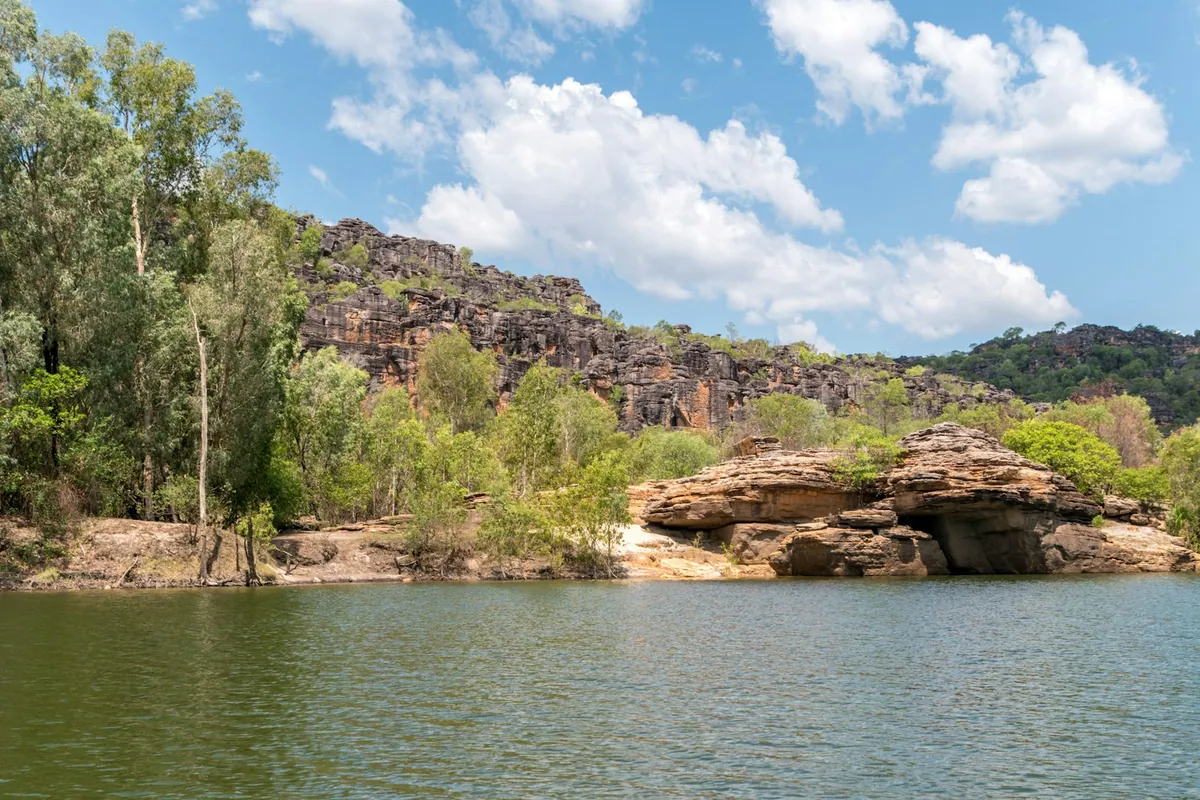
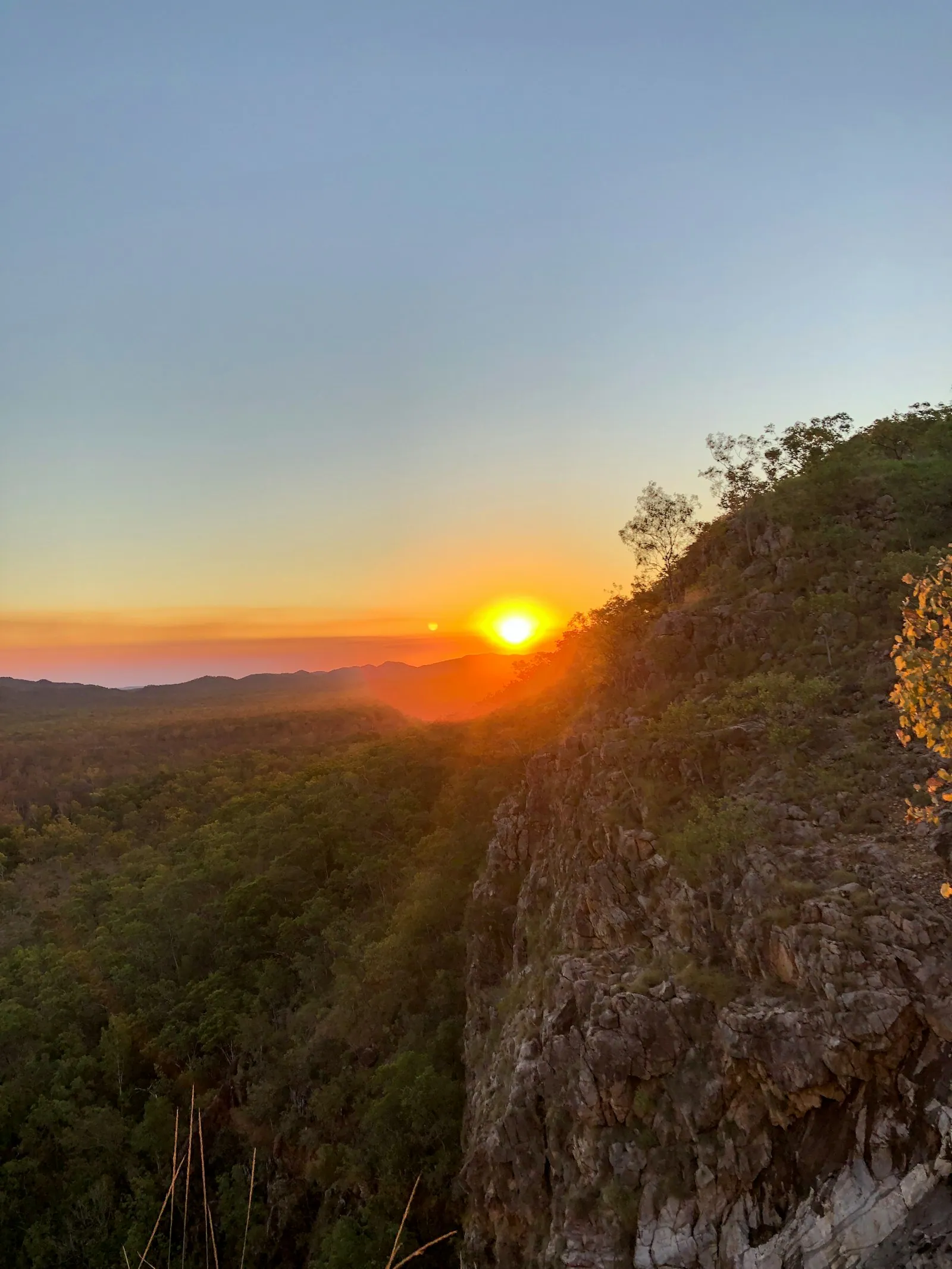
After the rock art, climb to the top of the Ubirr outcrop. It’s a short scramble, maybe ten minutes. The view is the one you’ve seen in every Kakadu brochure: the Nadab floodplain stretching out flat to the west, the eastern Arnhem Land escarpment rising in the distance, and in the foreground tropical woodland dotted with paperbarks. Stay for sunset. The ranger will walk up with the group. Nobody speaks much. The light does the work.
The next morning, drive to Nourlangie (Burrungkuy). Similar idea — ancient rock-art galleries in a sandstone outcrop — but the paintings are different, the stories different, the ranger walk different. There’s an image called the Lightning Man, Namarrgon, standing tall with axes coming out of his joints, that is one of the most iconic pieces of Indigenous Australian art. Seeing it in person, on the rock wall where it was painted, is a different thing from seeing it on a postcard. It is a presence.
Day three: Yellow Water cruise
Kakadu’s wetlands are what you picture when you picture the Top End. Yellow Water, near Cooinda, is a permanent billabong on the South Alligator River floodplain — paperbark forests drowning in shallow water, lily pads the size of dinner plates, saltwater crocodiles lying on the banks, sea eagles in the paperbarks, jabiru storks stalking the shallows. The Yellow Water cruise is a ninety-minute boat trip from the Cooinda Lodge jetty and, even in a park that gets under-visited, it is popular for a reason.
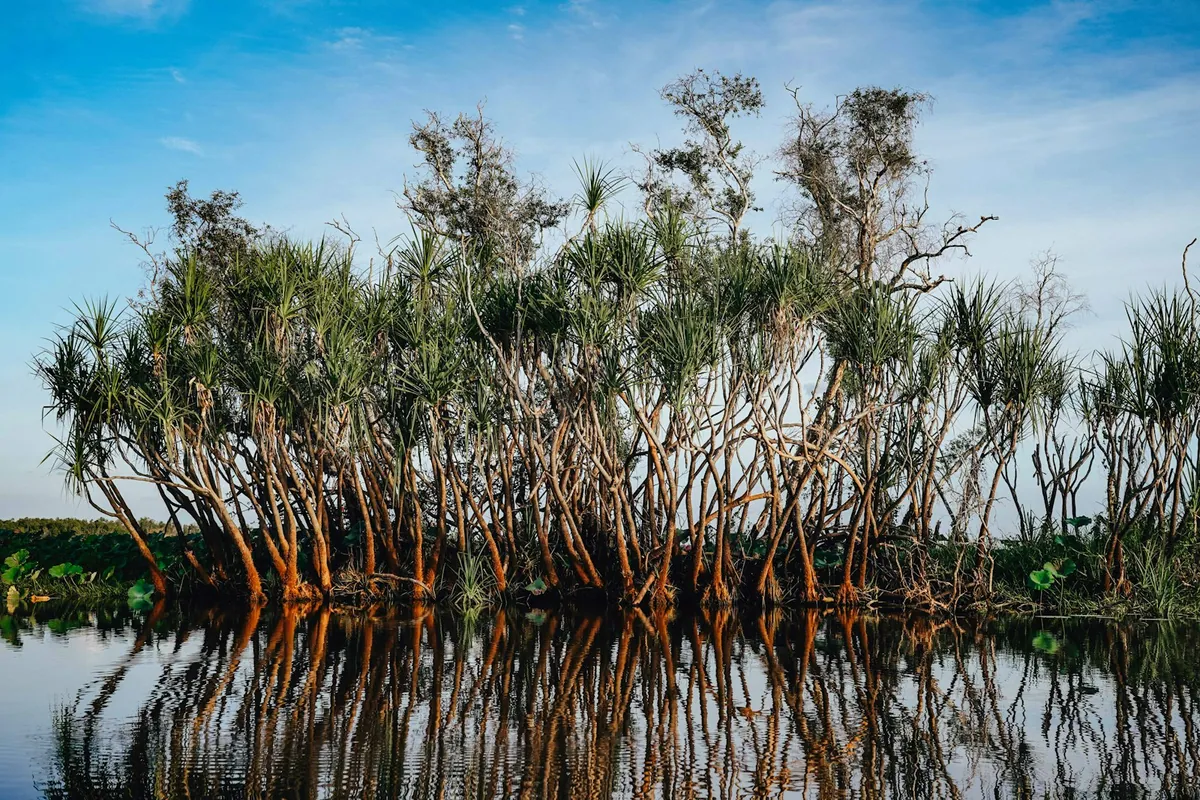
I did the 6:45 a.m. cruise. Mist was still lifting off the water. Within the first fifteen minutes we had seen two estuarine crocodiles, a six-foot olive python in a paperbark tree, a sea eagle with a barramundi in its talons, thousands of magpie geese, and a dawn-orange sunrise that turned the lily pads into small pink plates. Our guide was an Aboriginal man named Scotty. He was maybe the calmest person I met in Australia. He pointed to birds we couldn’t see and then we could. He told us which pandanus the traditional owners still use to make baskets. At one point he eased the boat up alongside a crocodile that was maybe two metres away, killed the engine, and we drifted past for a slow sixty seconds while the croc did not open his eyes.
Day four: Jim Jim Falls and Twin Falls
This is the hard day. The drive in is 60 kilometres of corrugated gravel, 4WD essential, often closed in the wet season and early dry. Jim Jim Falls at the end of the track is a 200-metre sandstone cliff with a waterfall pouring down it into a deep, dark-green, fresh-water plunge pool. The walk from the car park is about 900 metres of scrambling over boulders to reach the pool. You swim in it. You swim out to the base of the falls. The water is cold in the way only deep desert water is cold — black cold, shock cold.
Twin Falls, a short drive further, is a companion site: a second set of falls flowing into a gorge, accessible by boat shuttle through the gorge (run by the park concessionaire) followed by another short hike. Together, Jim Jim and Twin Falls are a full day. Pack lunch, pack water, pack a second shirt, bring a dry bag.
Day five: the southern waterfalls — Gunlom and Maguk
Gunlom Falls is where the Crocodile Dundee swimming scene was filmed. It’s on the southern edge of the park, about two hours’ drive from Cooinda, and it has two separate swim spots: the big plunge pool at the base of the falls (flat, sandy-bottomed, easy access) and the famous infinity pool at the top, reached via a steep 1-kilometre climb up the escarpment. The infinity pool is a series of rock pools at the edge of the cliff, and you can lean over the lip and look straight down onto the plunge pool 80 metres below. The view west across the Top End from the pool is one of the great Australian photographs.
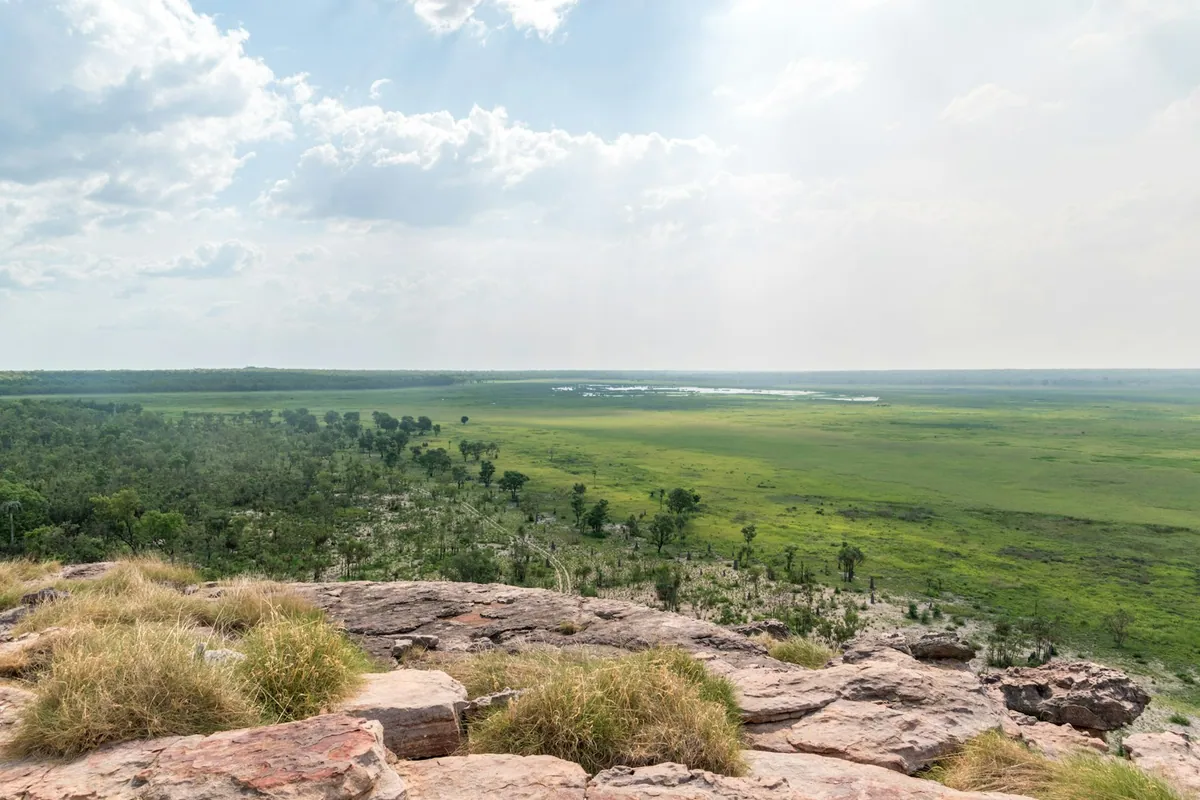
(A note: the top-of-Gunlom pool was closed for a period because of damage to a sacred site; check the current status with the visitor centre before you plan the climb.)
Maguk, an hour north, is a smaller waterfall with a long, deep plunge pool and a lovely two-kilometre walk in through monsoon forest. Less famous, much less busy, arguably lovelier. Swim here if Gunlom is crowded.
Day six: slow drive out, Adelaide River window, jumping crocodiles
On the way back to Darwin, stop at the Adelaide River about ninety minutes east of the city. The jumping-crocodile cruises here are, on paper, kitsch — the guides dangle meat on poles and the saltwater crocodiles leap vertically out of the water to grab it — and in practice genuinely wild to witness. A five-metre crocodile can launch its entire body out of the water. It is, briefly, terrifying, and then hilarious. You’re on a boat behind mesh. You are safe. The croc isn’t.
How nice are Territorians?
Loud, drawling, deeply decent. Within six days I had: a ranger at Cooinda let me into the staff washing machine because mine was full of red dust; a tour guide at Ubirr hand me his binoculars and tell me to keep them for the afternoon; a roadhouse owner at Mary River press a bag of kangaroo jerky into my hand as a parting gift “because you paid in cash, mate, I like that.”
If you go
• Dry season only (May–October). The wet-season floods close half the park and the rest is humid beyond description. • Rent a 4WD. Some roads are 2WD-friendly; Jim Jim and Gunlom are not. • Stay inside the park at least two nights. Cooinda Lodge is basic but well-placed; the campgrounds are excellent if you’re camping. • Book ranger-led activities ahead — Ubirr sunset, Yellow Water, Nourlangie. They are free or cheap and they are the heart of the park. • Bring more water than you think you need. The Top End pulls it out of you.
Kakadu doesn’t announce itself. It is big, quiet, ancient, and unhurried. Give it a week. It changes the shape of your attention. Mine, six months later, still isn’t back to normal.