Margaret River: Wineries, Karri Forest and Cape Naturaliste
Three days in south-west Western Australia — chardonnay, surf breaks, towering forests and one of the loveliest coastlines in the country.
📍 Margaret River, Western Australia, Australia
Margaret River is the south-western corner of Western Australia and the kind of region that, even by Australian standards, has an unfair distribution of good things in a small space. In a 100-kilometre stretch between Cape Naturaliste in the north and Cape Leeuwin in the south, you get: more than a hundred wineries (many of them world-class, several of them with cellar doors that are themselves architectural worth), forty-odd surf breaks (one of which hosts a leg of the world tour every year), a network of ancient karri and jarrah forests with trees forty metres tall, a coastline of empty white-sand beaches with limestone bluffs and sea caves, a famously good food scene (cheese, olives, marron, pork, chocolate, gin), and a population of small, scattered towns with the pace of a region that does not feel rushed by anyone.
Three days is the right length for a first visit. You will plan the next one before you leave.
Getting there
Margaret River is three hours south of Perth. Hire a car at the airport, drive south on the Kwinana Freeway, then south-west towards Bunbury and on to the Margaret River region. The town of Margaret River itself is the obvious base; Dunsborough at the northern end and Augusta at the southern end are quieter alternatives.
Day one: arrive, eat, drink, and the river mouth
I arrived around midday and went straight to lunch. Vasse Felix, the founding winery of the region (planted 1967), has a cellar door and restaurant tucked into the trees a few kilometres north of Margaret River town, and the lunch menu is excellent without being precious. I had the chef’s tasting plate, a glass of their flagship chardonnay, and watched a kookaburra steal a chip from the next table. The waiter told me the kookaburra had been doing this for five years and was unbothered by management.
After lunch, drive west to the river mouth at Surfers Point — the actual mouth of the Margaret River, where it meets the Indian Ocean. The car park is at the top of the cliff. Walk down to the beach. Out beyond the river bar, there’s a wave called Main Break that, when it’s on, hosts the Margaret River Pro and is one of the most powerful waves in the country. Even on quiet days the lineup looks serious. I watched for a long time and did not paddle out, because I am sensible.
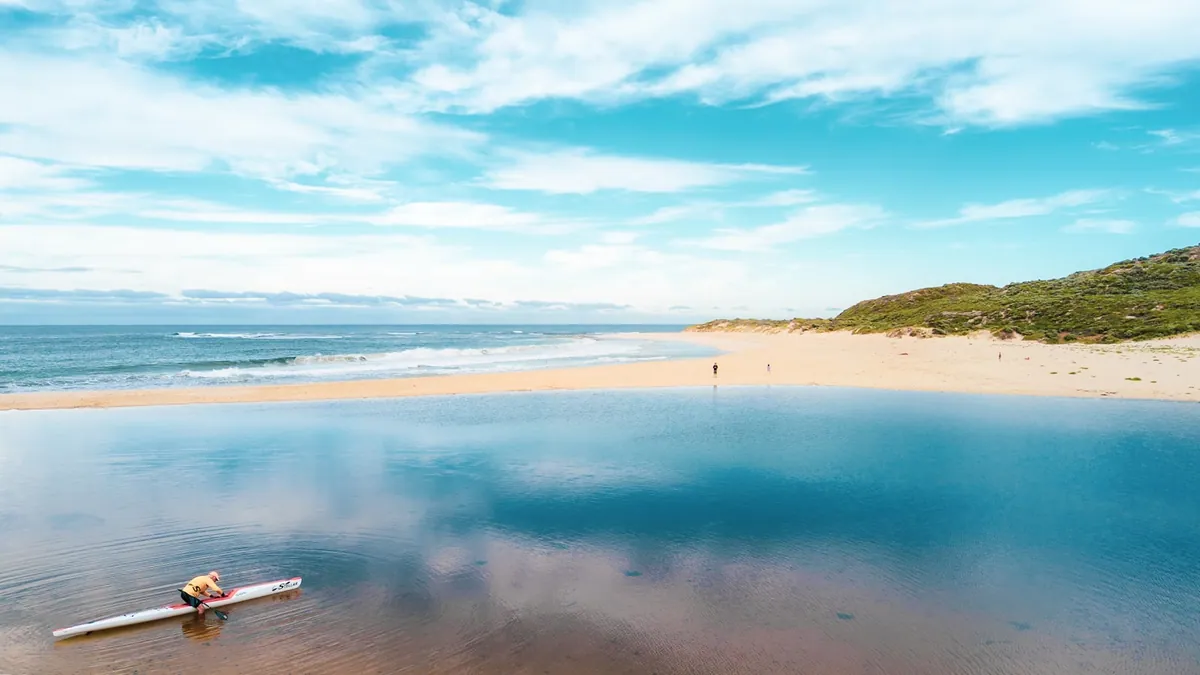
Walk south along the beach to the river mouth itself. The sand is bright. The water is two colours: ocean turquoise on one side of the bar, river tannin-brown on the other. The boundary between them is sharp. Birds wheel overhead. A pair of dolphins came past while I sat on a rock; one of them surfaced about ten metres from me and breathed audibly. I have never been able to take a good dolphin photograph in my life. I did not try this time.
End the afternoon at one of the many small wineries you will pass on the drive back. Cullen, Stella Bella, Voyager Estate, Leeuwin Estate — all serious; all welcoming; all expecting you to taste a flight without buying anything (though you should, because the wines are very good).
Day two: cape to cape — Sugarloaf Rock and the lighthouse
The Cape to Cape Walk runs the entire length of the region — 124 kilometres from Cape Naturaliste in the north to Cape Leeuwin in the south, hugging the coast. Most visitors do small sections of it as day walks. The northern end is the most accessible.
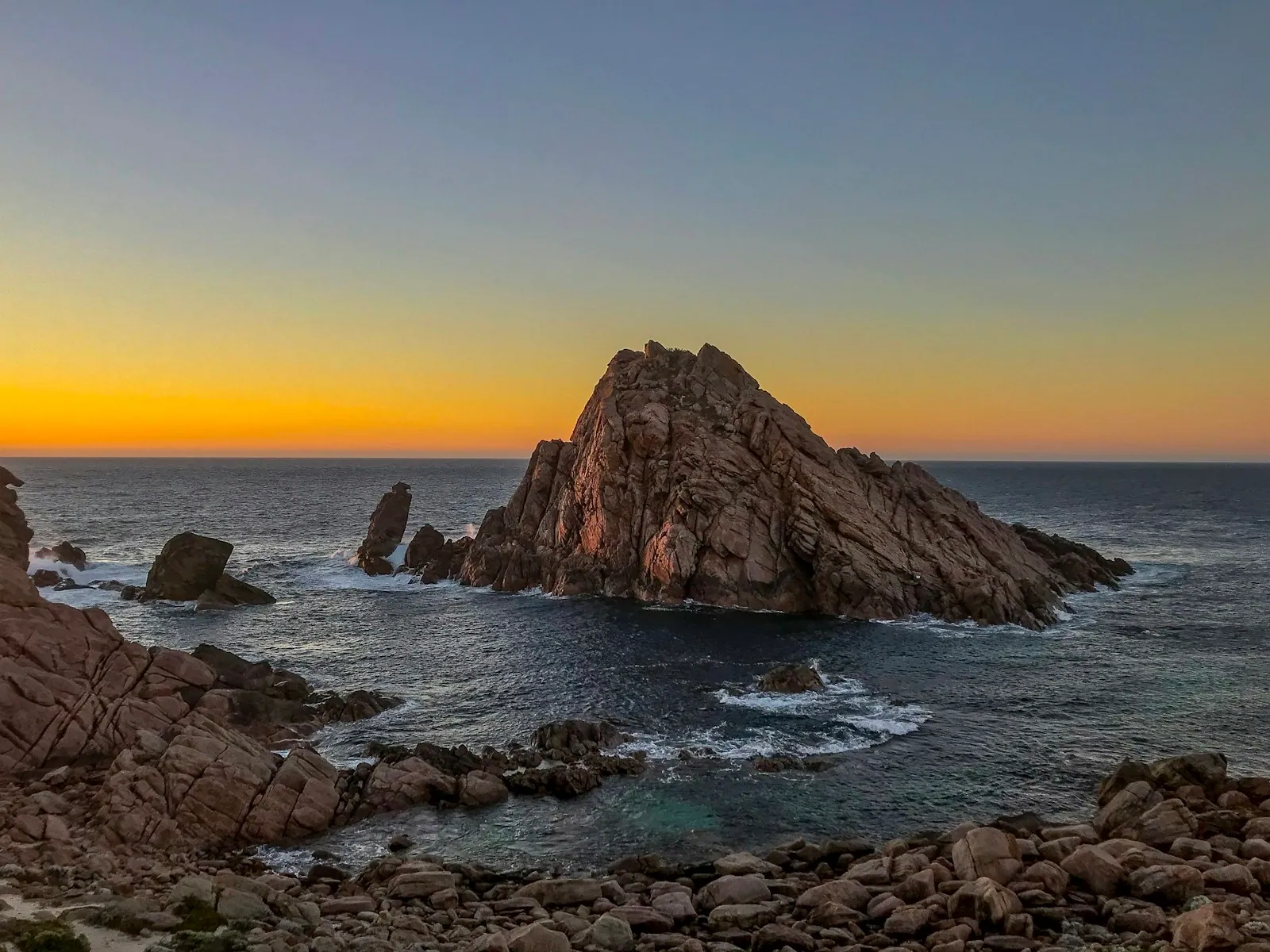
Drive north to the Cape Naturaliste Lighthouse. The lighthouse itself is small and elegant, perched at the northern tip of the cape, with sweeping views over Geographe Bay. There’s a gentle path that loops around it. From there, it’s a 3-kilometre coastal walk south to Sugarloaf Rock — a striking pyramid-shaped granite stack rising out of the ocean about eighty metres offshore. The walk is undulating but easy: low coastal heath, banksias and grass trees underfoot, the Indian Ocean a constant presence on your right.
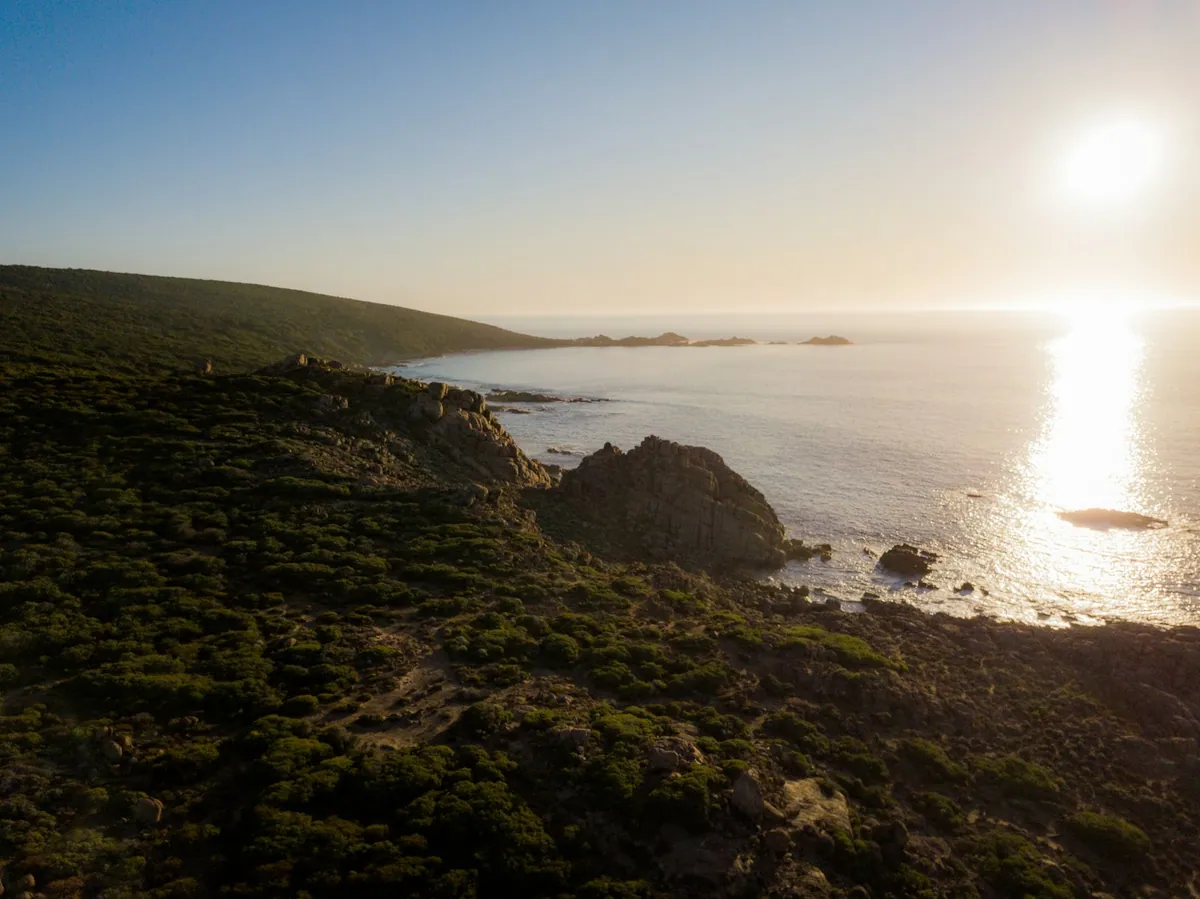
Sugarloaf Rock at sunset is one of the iconic Western Australian images. The rock itself is home to the southernmost colony of red-tailed tropicbirds in the world, and you can sometimes see them wheeling around the summit at dusk. I stood at the lookout for an hour as the sun dropped behind the rock and the sky went peach, pink, indigo. A couple from Bunbury who’d been coming to this spot every year on their wedding anniversary for thirty-two years told me, when I asked, that the rock had not noticeably changed. They had photos to prove it.
Drive into Dunsborough for dinner. The town is a relaxed beachside village with several excellent small restaurants. Eat at the Pourhouse, or — if you have the budget — drive a few minutes inland to one of the winery restaurants. The seafood here is some of the best in the country.
Day three: Boranup forest and the southern caves
Heading back south, take the Caves Road instead of the highway. This is the scenic road that runs near the coast through some of the most beautiful country in the region. Stop at Boranup Forest — a stand of karri trees, sixty metres tall, golden-trunked, the kind of forest that makes you feel about the size of a beetle in the best way. There’s a short walking loop and a longer drive-through. You can do either.
A few kilometres south, the Caves Road passes the entrance to Lake Cave and Mammoth Cave — two of the dozens of limestone caves in the region open to the public. Both are guided tours. Lake Cave is the most spectacular: you walk down 350 steps into a sinkhole, then enter the cave and emerge into a cathedral chamber with a permanent freshwater lake, and a “suspended table” — a rock formation like a stalactite that hangs over the lake without touching it. The guide will turn out the lights for thirty seconds at the deepest point. The dark is absolute. Then a single torch comes back on and the lake catches the light. People audibly gasp. Worth doing.
If you have time, push on to Cape Leeuwin at the southernmost tip of the region. The lighthouse here marks the meeting point of the Indian and Southern Oceans, and you can stand on the platform at the base and watch two oceans collide. There is a marker stone on the path that says, simply: “the meeting of two oceans.” It feels like the end of something.
What surprised me
• The size. The region looks compact on a map. It is not. Allow a full day for the southern half and a full day for the northern half. • The trees. Karri forest is something I had never experienced. Goose-bump-inducing. • The wineries. I had been to wineries before. None of them came close to the Margaret River cellar door experience for value, friendliness, and quality. • The friendliness. Everyone here, from the lighthouse keepers to the restaurant staff to the cave-tour guides, has time. WA in general is unhurried; this corner of it is the unhurried-est. A vineyard restaurant manager once spent twenty minutes with me drawing a list of wineries that suited my budget on the back of a paper menu. He didn’t recommend his.
If you go
• Three days minimum. A week is better. There is no shortage of things to do. • Hire a car. Public transport between the wineries doesn’t exist. • Use one of the regional driver services if you’re cellar-door hopping. Drink-driving is taken very seriously, and rightly. • Book the Lake Cave tour ahead. Times are limited and it sells out. • Pack layers. The wind off the Indian Ocean can drop the temperature ten degrees by sunset.
Margaret River is the kind of place you visit once, for three days, and then mentally schedule a return for the following autumn. I have. Mine is in May. The wineries will not have moved. The karri forest will be the same. The dolphins will, probably, still come past. Western Australia rewards patience — and Margaret River is the most patient corner of the most patient state in the country.