Sunrise at Uluru: Three Quiet Days in Australia’s Red Centre
A monolith, a guide called Tjampu, and the loudest silence I’ve ever heard.
📍 Uluru-Kata Tjuta National Park, Northern Territory, Australia
The thing nobody quite tells you about Uluru is how thoroughly you have to commit. There is no “drive past on the way to somewhere else.” There is no “we’ll fit it in over the weekend.” You fly to a tiny airport in the middle of the desert, you check into a resort surrounded by red sand, and for three days the rest of the world recedes by about a thousand kilometres, which is roughly what it actually does. You are out there. The phone signal is fine. The satellite of your normal life is not.
I had three days in the Red Centre. They were among the most rearranging days of my life.
Day one: the size problem
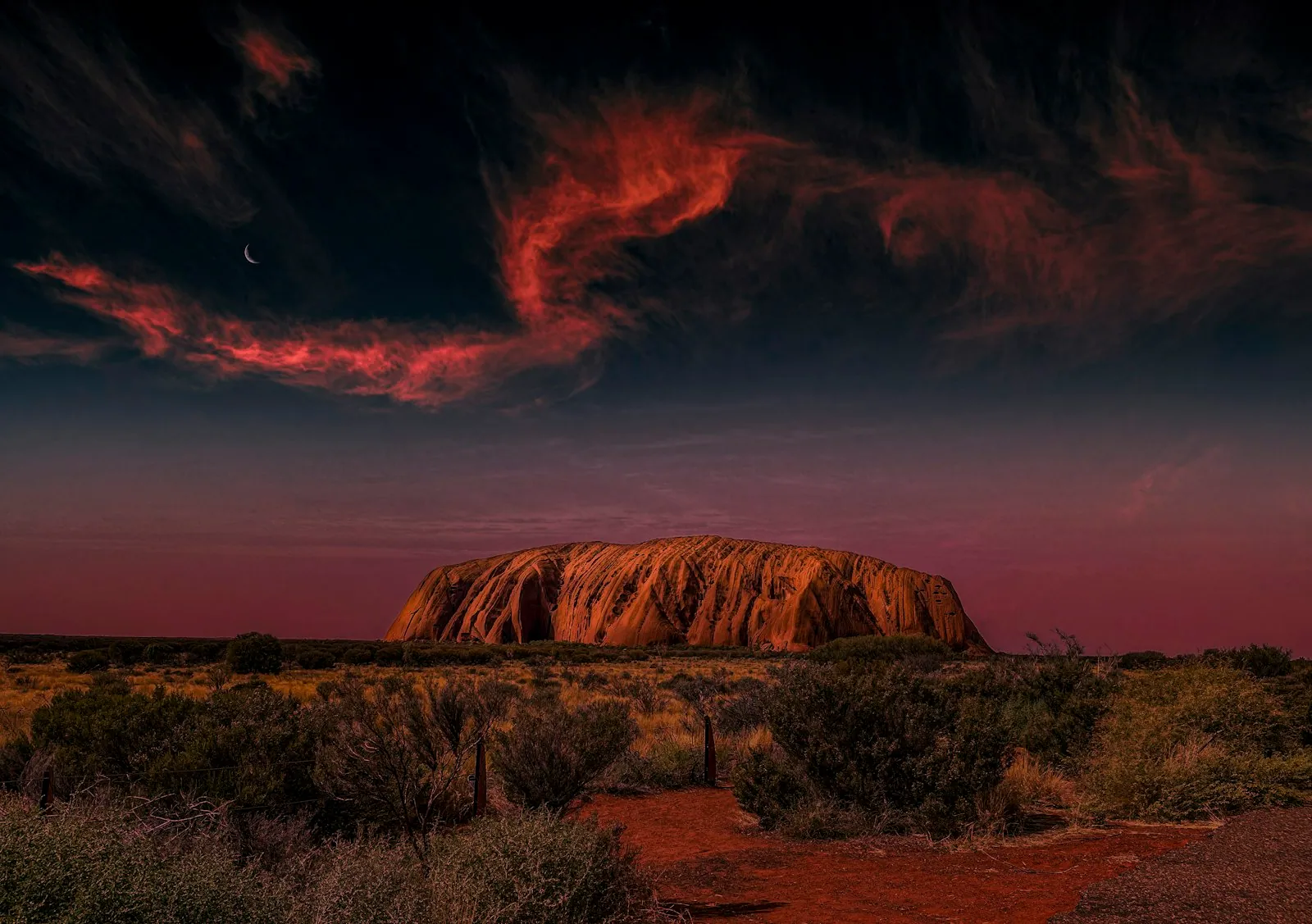
I knew Uluru was big. Everyone knows Uluru is big. The number you usually hear is “twice the size of the Eiffel Tower,” which means nothing to most of us because the Eiffel Tower is a metal lattice and Uluru is a 348-metre-tall sandstone monolith with a base perimeter of nearly ten kilometres. The number-fact does not prepare you for what your eyes do when you see it.
I saw it for the first time from the bus from the airstrip. It was an hour before sunset. Uluru was at the end of a flat plain of spinifex and red dirt, and as we drove towards it, it kept refusing to get larger. That was disorienting. Most landmarks loom. Uluru does not loom; it sits. Then suddenly, when you’re a few kilometres out, your brain gets the scale right and the rock fills the windshield and your stomach drops a little. The bus was quiet. People who had been chatting stopped chatting.
I had booked into a small lodge in the Yulara resort village, dropped my bag, drank a litre of water (you forget how dry the desert is until your tongue starts feeling like felt), and made my first decision: skip the big sunset crowd at the famous viewing area and walk fifteen minutes to a quieter dune behind the lodge. Locals had told me to do this. Locals are always right.
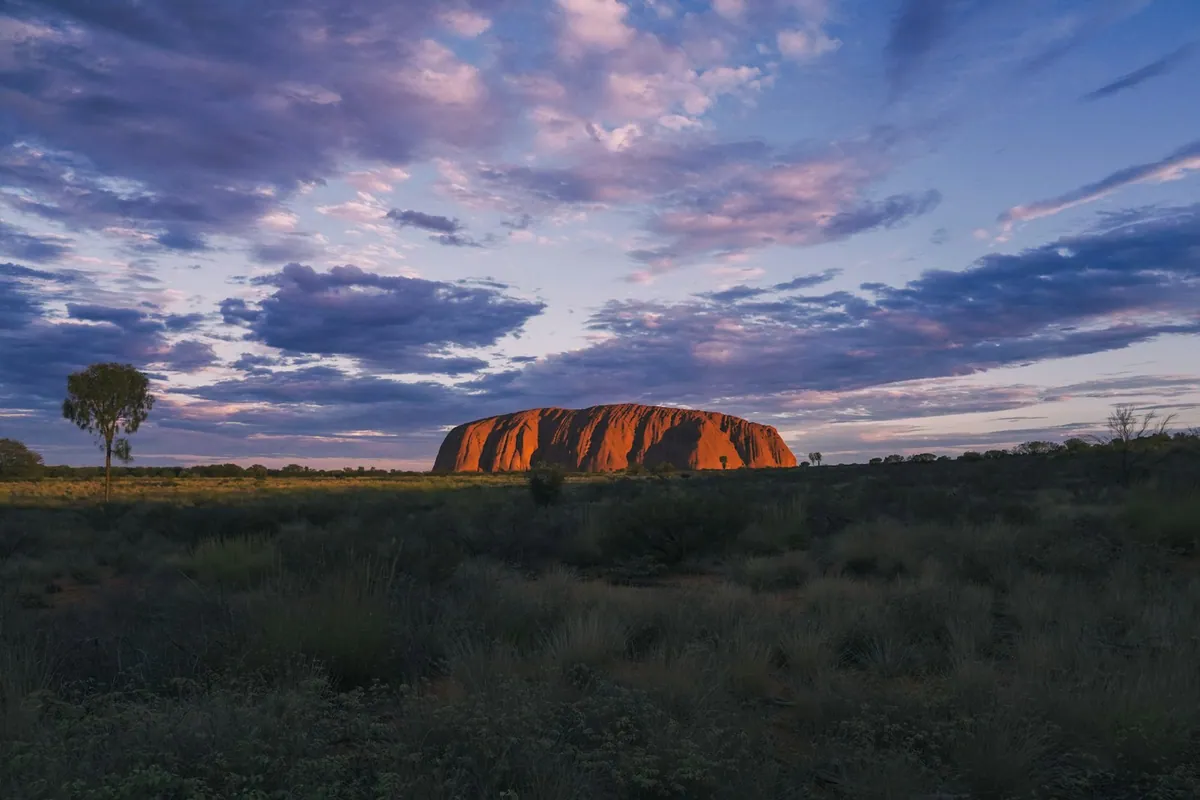
The sunset was — forgive me — a sunset. Glorious, sure. The rock turned that mineral-orange colour the postcards promise. But the thing that surprised me was the *quiet*. There were maybe ten of us on the dune, all strangers, all silent. Out beyond Uluru, fifty kilometres west, the domes of Kata Tjuta were silhouetted in the last light. A black-faced cuckoo-shrike called somewhere behind me. The sky did its show. We watched.
Day two: the base walk
I had read that the proper way to know Uluru is to walk around it. The full base walk is 10.6 kilometres on flat, well-formed paths. They suggest you start at sunrise to beat the heat, even in the cooler months, so I was at the trailhead at 6 a.m. with a hat, three litres of water, and the kind of sleep deprivation that makes everything seem mildly miraculous.
What you don’t see in the photographs is that Uluru is *not* a smooth dome. Up close, it’s a series of caves, gorges, waterholes, sheer faces, vertical scars where slabs have peeled away over millennia, and dense pockets of trees — ghost gums and bloodwoods — that have made small green tucks in the rock’s shadow. Birds love it. Wallabies live in the caves. There’s a permanent pool called Mutitjulu Waterhole on the south side that’s deep enough to hold water for years between rains.
There are also signs at certain places — culturally sensitive sites — asking you not to take photographs. Most are sacred sites for the Anangu, the Aboriginal traditional owners of the land. I respected the signs. Everyone I saw respected the signs. There is a particular small grace to walking past one of those places, lowering your camera, and just looking.
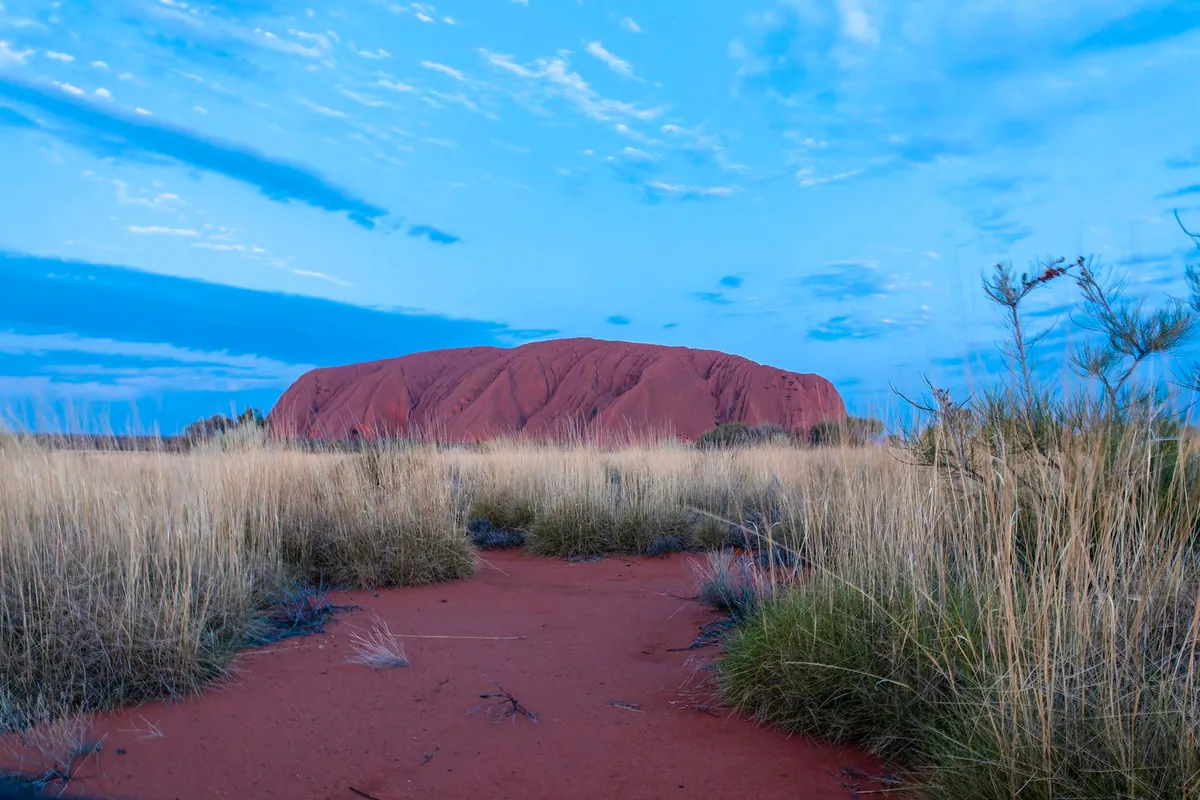
I finished the walk in just over three hours. I sat on a bench in the shade of a desert oak at the end and ate a peanut-butter sandwich. An older couple sat down next to me, both Australian, both done with the walk. The woman asked if I had been to Mutitjulu yet. I had. “Beautiful, isn’t it,” she said. “My grandkids think it’s magic. I think they’re right.” Then she pointed at my shoes and said: “wear the right socks tomorrow, love, you’ve got blisters coming.” I had. They were. The mums of Australia know.
Day two evening: a guide called Tjampu
The single best thing I did in the Red Centre was a small-group cultural walk with an Anangu guide. There are several operators that run them; the licence to do this work in the park is given only to traditional owners and a small number of accredited cultural educators. My guide that afternoon was a man who introduced himself as Tjampu, in his sixties, wearing a long-sleeved shirt and a wide hat and a quiet that took up its own space in the group.
We walked a short loop near the southern face. He pointed out plant medicines: a small bush whose leaves cleared sinuses, another whose berries you could eat in the cool months. He showed us tracks in the sand and patiently asked us what we thought had made them. (Answer in nine cases out of ten: a perentie, a big sand-coloured monitor lizard.) He taught a few words of Pitjantjatjara, gentle words, hello and thank-you words.
Then he stopped at a wall of rock and told us a story. I won’t reproduce it here — Anangu stories belong to Anangu, and what gets told to visitors is told for the moment, not for the internet. But I will tell you the structure. The story explained why a certain feature of the rock looked the way it did. It tied geography to morality, animals to ancestors, the past to the way you should walk on the country today. It took maybe twenty minutes to tell. There was a silence at the end that I have rarely felt outside of churches.
When the walk ended, Tjampu shook everyone’s hand. He told me my hat was good. He said: “you come back, eh? You bring your kids. We’ll be here.” The casual generosity of that, after centuries of generosity not being returned, has been bouncing around inside me ever since.
Day three: Kata Tjuta
The Olgas, as they used to be called, sit fifty kilometres west of Uluru and are arguably the bigger surprise. Thirty-six dome-shaped rocks, the tallest 546 metres, clustered together like loaves of bread on a baker’s tray. There are two main walks: the Walpa Gorge stroll, easy and short, and the Valley of the Winds loop, which is longer (about seven kilometres), more strenuous, and worth every step.
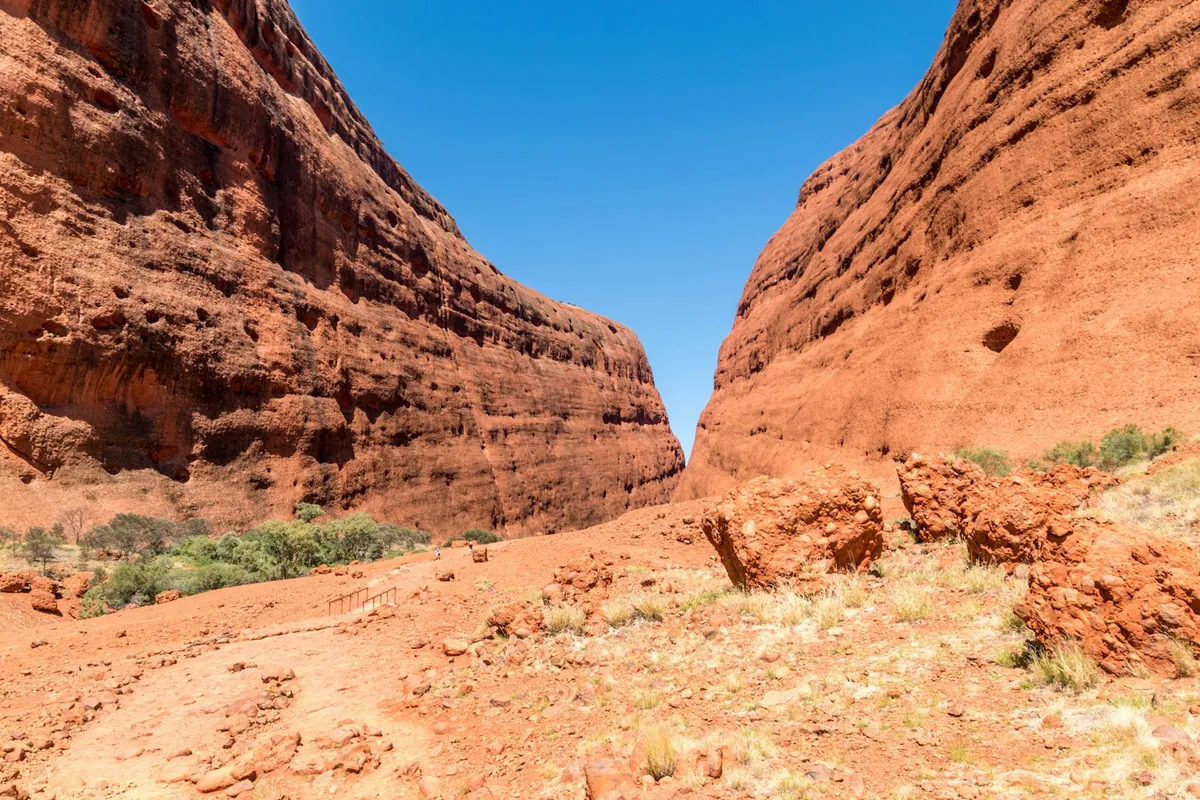
I did Valley of the Winds at first light. The walk takes you up into the gap between two of the biggest domes — a wind tunnel where the breeze is permanently funnelled and the temperature drops a few degrees — and then on into the inner valley, where you walk between sheer red walls a hundred metres tall. Birds wheel overhead. Wallabies appear and vanish. The path goes up, it goes down, it goes around, and at one of the higher saddles you get a view back across the desert towards Uluru that makes you feel about as big as a beetle. In the best possible way.
I sat on a rock, drank water, and tried not to cry into my muesli bar. I have a slight pattern, I am noticing.
What surprised me
• The crowds are smaller than you fear. The park caps numbers, the resort village is small, and once you’re on a walk you mostly meet ones and twos. • The cold. Desert nights drop to single digits even in autumn. Pack a fleece. Pack two. • The food. The Field of Light dinner experience — a sound-and-light installation in the desert with a multi-course bush-tucker menu — is touristy but undeniably gorgeous. Worth it once. • The friendliness. Everyone in Yulara, from the bus drivers to the souvenir staff to the German guests in the lodge sauna, talks to you. Within the first day I had three sets of contact details from Australian families who said: “if you’re ever in Adelaide / Wagga / Geelong, mate, give us a call.” That is, again, a thing they actually mean.
If you go
• Fly into Ayers Rock Airport (AYQ) on Qantas, Jetstar or Virgin. The resort is a ten-minute shuttle from the runway. • Allow at least three days. Two is do-able but you will leave wishing you’d had the third. • Book one cultural tour with an Anangu guide. Don’t skip this. It is the difference between seeing the rock and beginning to know it. • Sun protection isn’t optional. Long sleeves, hat, sunglasses, three litres of water minimum even on cool days. • Don’t climb Uluru. The climb has been formally closed since 2019 — and was always against Anangu wishes — and the base walk is the better experience anyway.
I left the Red Centre on a 6 a.m. flight that pushed back as the sun was lighting the rock pink one last time. Half the cabin was at the windows. The pilot tipped the wing slightly so the side without the view could see. Even the airline’s being decent here. I don’t know why I’m surprised any more.