Tasmania Off-Grid: Cradle Mountain, Wineglass Bay and Hobart’s Hidden Charm
A week-long loop around Australia’s smallest state proves it punches absurdly above its weight.
📍 Tasmania, Australia
Tasmania is one of those places that Australians on the mainland will discuss in slightly hushed tones, like they’re telling you about a weird cousin who’s extremely talented. “The food is unreal, mate.” “The hiking is unreal.” “You’ll never want to come back.” This level of hype is, statistically, a setup for disappointment. Tasmania does not disappoint. Tasmania is the rare destination where the over-claim turns out to be roughly accurate. Here is what a week looks like there if you actually want to feel the place.
Why a week
The temptation with Tassie is to do a long weekend in Hobart and call it done. Don’t. The island is small — it’s the size of Ireland, give or take — but the road network is full of bends, the speed limits are sensible, and you’ll move at maybe sixty kilometres an hour on average. A week gives you time to do three regions properly: the wild west and Cradle Mountain in the highlands, Freycinet on the east coast, and Hobart in the south, with a couple of slow drives between them where you stop for cheese, gin, and the occasional wallaby.
I flew into Launceston on a Sunday afternoon, picked up a small SUV with all-wheel-drive (worth it for Cradle Mountain in autumn), and was at my first cheese-tasting within ninety minutes. This is the right pace.
Days one and two: Cradle Mountain
Cradle Mountain is two and a half hours west of Launceston by car, mostly through farmland that gets gradually wilder, and the last forty-five minutes are a winding climb through alpine forest into the World Heritage area. The visitor centre is the trailhead. From here, no private cars go further; you take a free shuttle bus to Dove Lake, where the famous postcard view is.
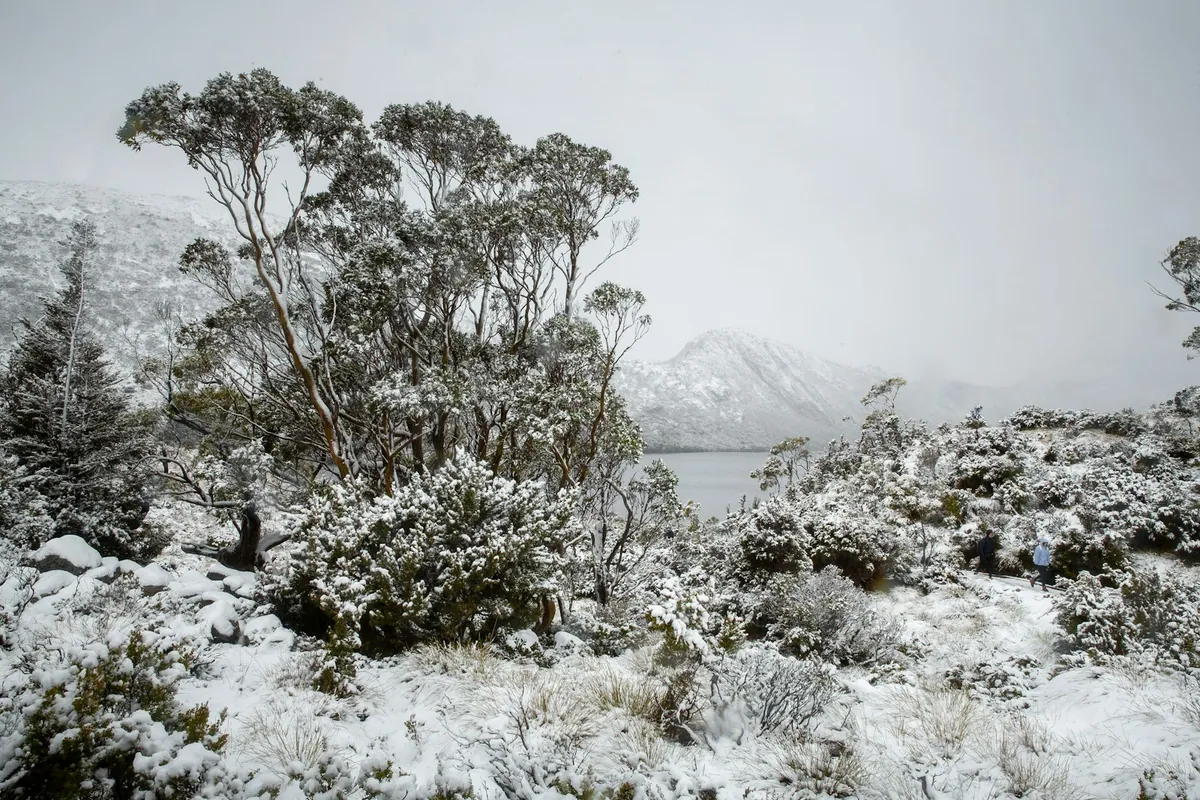
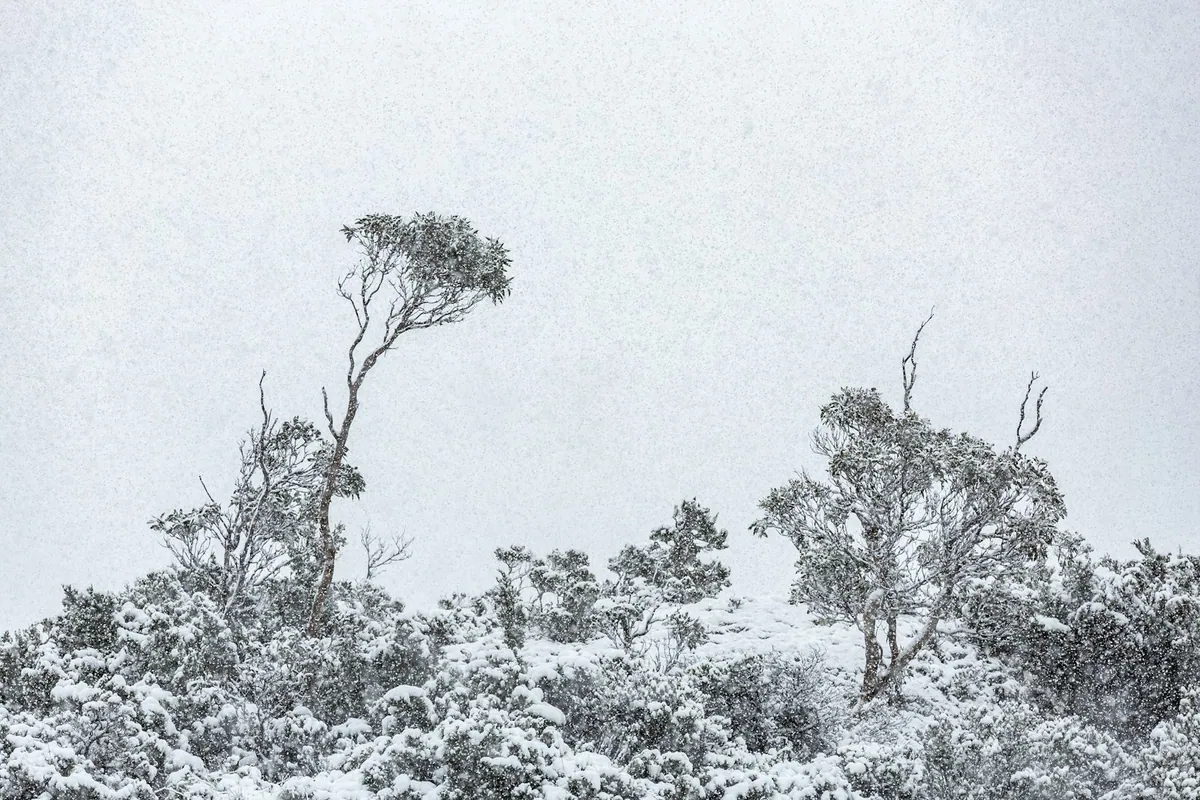
I went in late autumn. The fagus — Australia’s only deciduous native tree, growing in patches around the lake — was turning the colour of polished copper, and on my second morning, snow was falling on the higher peaks. The Dove Lake circuit is a six-kilometre, mostly-flat boardwalk loop that takes you all the way around the lake at the foot of Cradle Mountain itself. It is a near-perfect day walk: easy underfoot, a constant change of view, photo opportunities every two hundred metres, and the strange, hush-hush quality of a place where the wallabies are unbothered by you and the wombats wander past late afternoon to graze.
If you’re fit and have a calm-weather day, the Marions Lookout climb gives you the killer view down over Dove Lake from above. It’s steep — there’s a chained section near the top that I went up on all fours, like a small dignified bear — but it’s only a couple of hours round trip and the payoff is one of the great vistas of the Australian alpine.
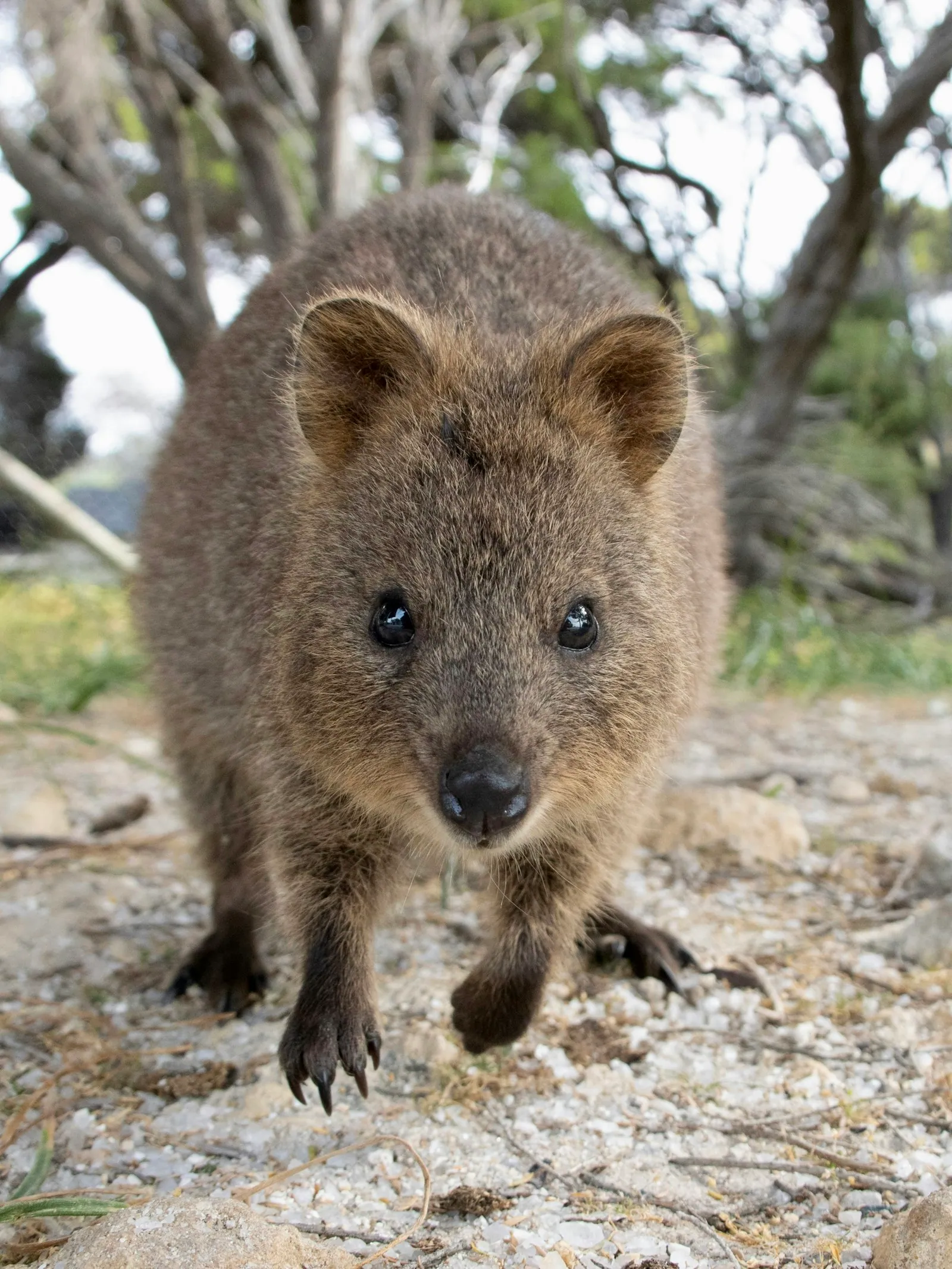
I stayed at one of the small lodges in the area. Each evening they had a wine-and-cheese hour where the staff would point out the wombats moving across the lawn outside, like a kind of hairy charity event. Wombats are essentially tanks made of muscle and mossy fur. They are, I want to say it carefully, the platonic ideal of an Australian. Stocky. Friendly enough. Quietly extremely competent. Surprisingly good at digging tunnels.
Day three: cross-country to Freycinet
The drive from Cradle to the east coast is one of the most underrated long drives in Australia. You go via the central highlands — a high, treeless plateau dotted with lakes that’s technically alpine — then drop down through Bothwell (a tiny town where Australia’s oldest golf course quietly exists, planted by Scottish settlers in 1822) and Ross (a sandstone village so picturesque it should be illegal). I had lunch in Ross at a bakery whose vanilla slice ranks in my personal top three. The baker, when he found out I was visiting, gave me a free scallop pie “for the road, love.” That kind of thing happens here a lot.
You hit the east coast at Swansea, turn north, and within thirty minutes you’re entering Freycinet National Park.
Days four and five: Wineglass Bay and the Freycinet coast
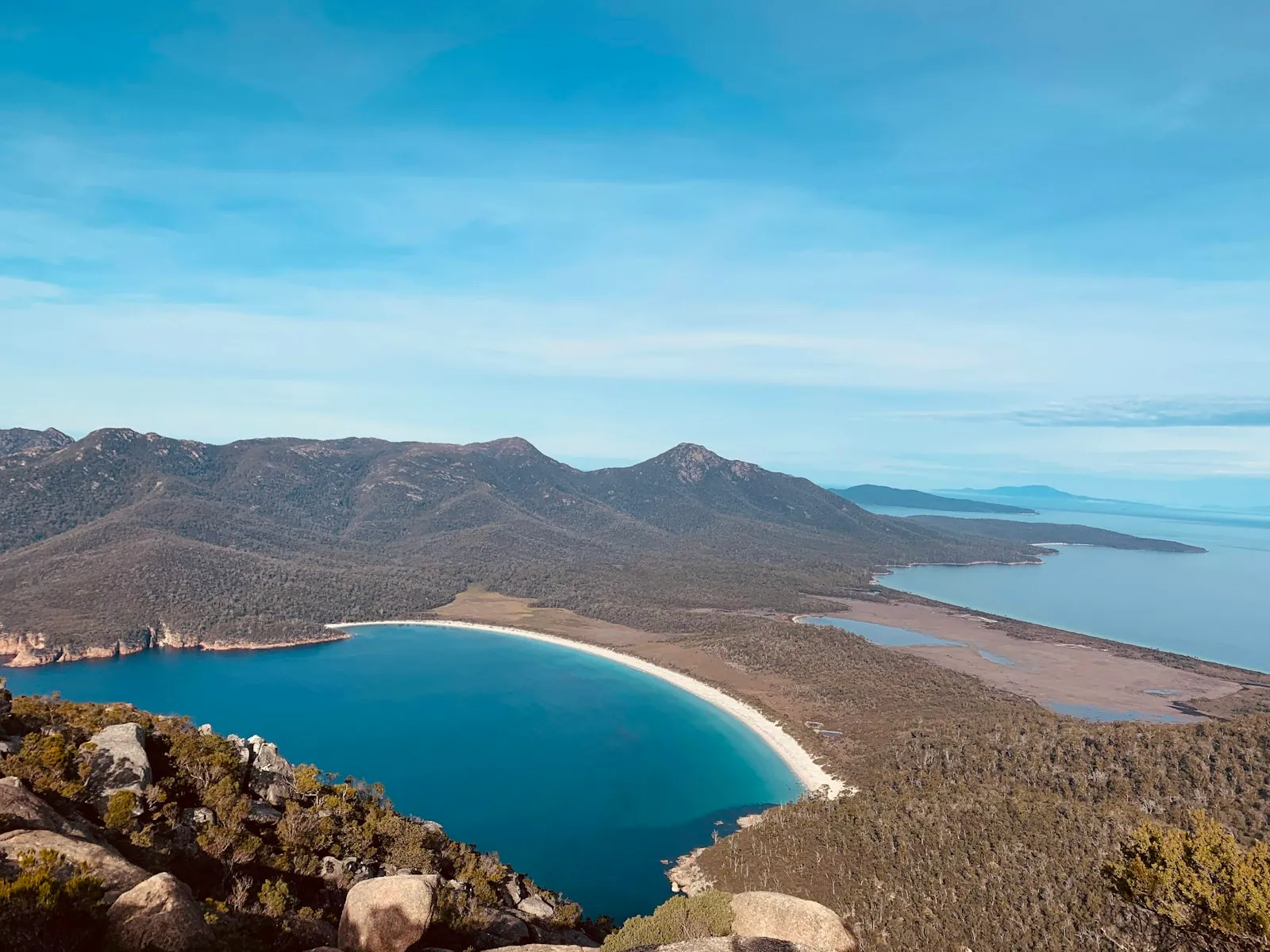
Wineglass Bay is the most photographed beach in Tasmania for good reason: it’s a perfect arc of white sand cupped between two granite peaks, with the Tasman Sea in the middle in a deep, ridiculous blue. There’s a lookout track from the car park that takes about an hour return and gives you the famous view from above. Then, if you have legs willing, you can keep going down to the beach itself and back up again — it’s a steep extra hour each way and it is absolutely worth doing.
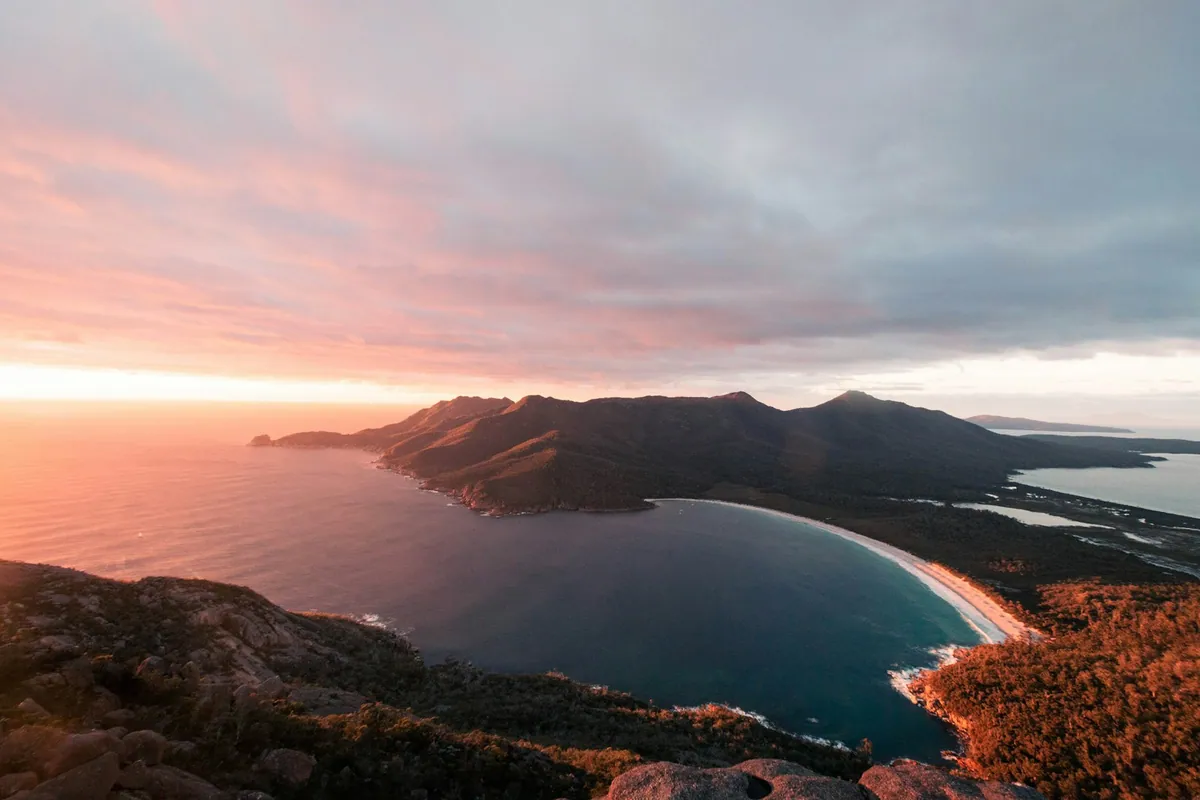
I did it at sunrise on day four. There were five other people at the lookout. The sun came up through a thin band of cloud, the granite turned pink, the sand was almost luminous, and a wedge-tailed eagle — wingspan of two metres, easy — cruised below us along the cliff face for a slow minute. I cried, again. I am noticing a pattern with Australia.
The other thing to do at Freycinet is the Hazards loop, a longer but flatter walk that takes you across the peninsula via Hazards Beach and back. The Hazards beach is the great unsung beauty of the park: an enormous, empty arc of pale sand with no infrastructure, no lifeguards, no one on it. You can swim in the cold clear water (it’s genuinely cold, even in summer; bring resolve) and walk for an hour without seeing another person.
Coles Bay, the village just outside the park, has a small handful of lovely places to eat. I had a wood-fired pizza one evening at a restaurant where the chef came out to make sure I’d enjoyed the Tasmanian pinot noir she’d picked for me. “That’s from the Tamar Valley,” she said. “We’re very proud of it.” It was excellent. They are right to be proud.
Days six and seven: Hobart and MONA
Hobart is small for a capital city — about 220,000 people — and it’s wedged between the Derwent estuary and Mount Wellington (kunanyi), which rises 1,271 metres above the harbour and is dusted with snow in winter. The waterfront is the heart of the place: sandstone warehouses converted into restaurants, fishing boats unloading at the wharf, a Saturday market at Salamanca Place that takes up several blocks and is, hands down, the best craft market in Australia.
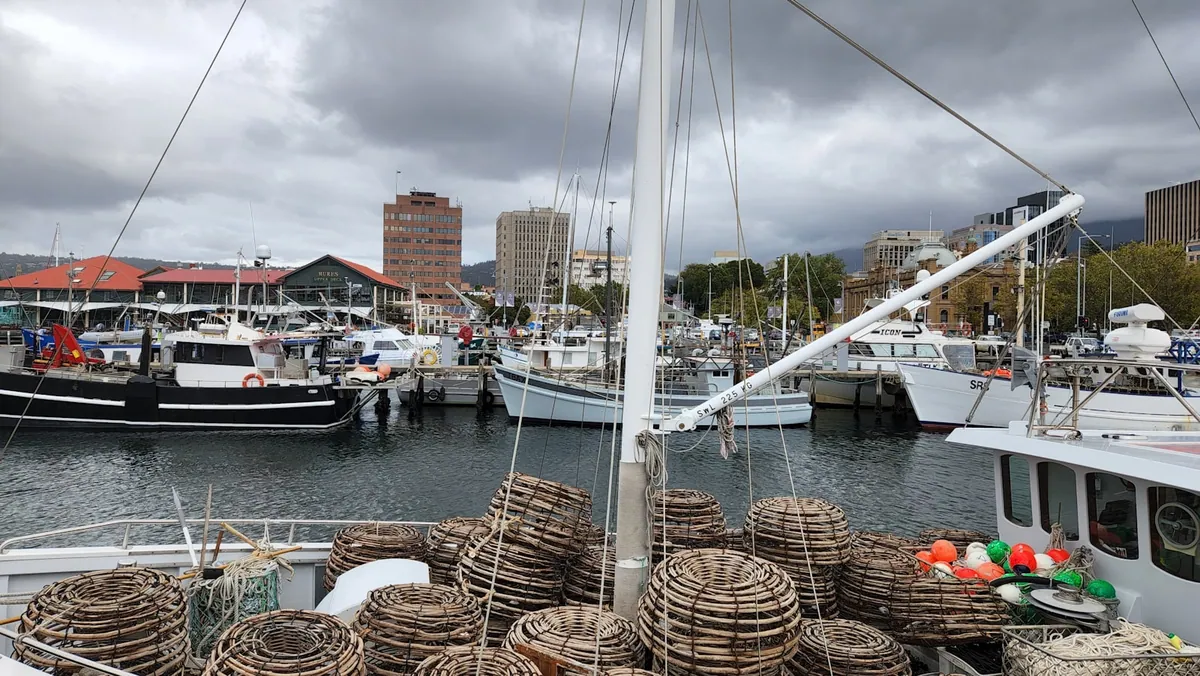
I spent my first day on foot — Salamanca, then a steep walk up Battery Point through the heritage cottages, then back down to the waterfront for fish at Mures and a beer at the Customs House Hotel. Hobart is a city you can do in a long weekend if you’re mostly walking.
The second day I dedicated to MONA, the Museum of Old and New Art, which is on the north side of the river. You take the MONA ferry — not the bus, the ferry; the ferry is half the experience — from the city centre out to the museum’s private dock, and you arrive at a vast underground gallery that David Walsh built into the side of a sandstone cliff with the proceeds of his professional gambling career. MONA is funny, sometimes obscene, occasionally devastating, and unlike any major gallery you’ve been in. The famous installation — the Cloaca Professional, an actual machine that digests food and produces waste at the same time each day — is the kind of provocation that defines the place. There’s also a James Turrell skyspace where you sit and watch a square of sky turn impossible colours after sunset, and a wing of medieval coffins hung from the ceiling like a chandelier of mortality.
I came out of MONA dazed. I sat on the ferry back into town with a glass of pinot from the on-board bar, watching Hobart’s lights come on across the water, and thought: this is a small place that thinks really, really big.
How nice are Tasmanians, exactly?
Even by Australian standards, Tasmanians are warm. There’s a slight insularity — mainlanders are gently teased — but it gets dropped instantly when you reveal you’ve come a long way to see the place. I had: a lodge owner at Cradle wake up at 5 a.m. to drive me a packed lunch I’d forgotten in his fridge; a bus driver in Hobart wait at a stop while I ran back to the cafe for the coat I’d left on the chair; a stranger at Salamanca Market hand me her umbrella when the rain started, refuse to take it back, and walk off into the downpour.
It is a real and consistent thing. The smaller the country town, the more pronounced. Bring it back home with you if you can.
If you go
• Fly into Launceston, out of Hobart (or vice versa) so you don’t backtrack. • Hire a car. Public transport between regions is patchy. AWD is overkill in summer; useful in winter at Cradle. • Pack layers and a warm jacket. Even summer days at Cradle can hover around 10°C. • Book Cradle Mountain accommodation early; the few lodges in the park sell out months ahead. • Try the cheese, the whisky and the gin. Tasmania does all three at world-class level. • Allow at least seven days. Ten is better. Three is a tease.
I left Tasmania on a 7 a.m. flight from Hobart with a bag of single-origin coffee, a wedge of cheddar wrapped in waxed paper, and the slightly vacant expression of someone who is already planning a return trip. Tasmania does that to you. Be ready.